“In its 8th edition, the Kosovo Architecture Festival will be addressing the issue of Publicness in our cities with a focus on Prishtina. The invited Future Architecture emerging creatives will be presenting to the local & global audience tools, methodologies and strategies of analyzing and reinterpreting publicness. KAF announced the Kosovo Architecture Festival 2020 program with more than 35 public lectures featuring 8 Future Architecture creatives and keynotes from Carlo Ratti the head of the Senseable City Lab at Massachusetts Institute of Technology, Nadar Tehrani the Dean of the Architecture School at Cooper Union, Malkit Shoshan of Harvard GSD &…
Save the date In 2021, the biennial students’ competition, organised by ICOMOS Germany with partner organisations, will again be dedicated to the young heritage after 1960. This time the focus will be on “Beton Brut” Architecture, i.e. literally on “raw” exposed concrete buildings and other examples of so-called brutalism. The competition will be launched at the beginning of 2021 and will have a closing date in September of that year. It is again aimed at students of architecture and urban planning, history of art, restoration, archaeology, or other heritage-related disciplines. The prizewinning entries are to be awarded on the occasion…
Through time, the borders have been inherent to human life since many believes, knowledge and actions are founded through territorial occupation, and create basic forms of difference, but among the scales of organization, without a doubt, the State has been predominate. Up to now, a variety of studies have focused on the phases of the construction of borders; and even though during the Cold War there was a diminish in its numbers and varieties, since the last three decades there has been an emergence in its interest up to reaching a variety of topics and perspectives that can been characterized…
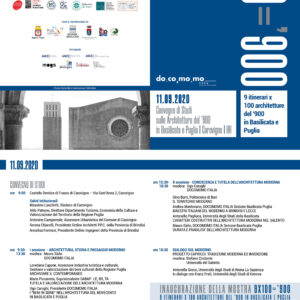
“9 x 100 = 900, 9 itinerari per 100 architetture del ‘900 in Basilicata e Puglia” is the title of the conference and exhibition dedicated to the modern movement architecture, organized by Docomomo Italy, 11th September 2020, in Carovigno. On September 11th, the conference, taking place at the Castello Dentice di Frasso, will deal with the relationships between architecture, history, landscape and modernity in the South of Italy. Followed the international conference on the architecture of the 20th century in Basilicata and Puglia, the traveling exhibition “9 itinerari per 100 architetture del ‘900 in Basilicata e Puglia”, organized by the…
The magazine Docomomo Brasil (ISSN 2594-8601) invites researchers, students and professionals in the field of Architecture and Urbanism to send articles for its issues 6 and 7. The topic is free and the journal aims to disseminate research, documents, projects and bibliographic reviews in the area of documentation and preservation of the various manifestations of the Modern Movement. Articles may be submitted to the sections that make up the main body of the journal. In the Project section, it is intended to disseminate and discuss practical experiences in restoring buildings, sites and neighborhood units and other artistic expressions of the…
Following the success of Docomomo Australia’s 2017 series “A Style Guide to Twenthieth Century Architecture”, Docomomo Australia is spreading the new series of online lectures of the British Twentieth Century Society: – Architectural Styles I: 30’s Modernism with Alan Powers – Architectural Styles II: Mid Century Modernism with Elain Harwood – Architectural Styles III: Neo Geo with Alan Powers For more information, please go to Docomomo Australia website and to Twentieth Century Society website.
Docomomo Chile, Centro del Patrimonio Cultural UC, Facultad de arquitectura, diseño y estudios urbanos UC and Escuela de arquitectura UC are holding their 1st Seminar, from 27th August to 8th October, online, with the theme “Women and Modern Architecture ”. The “First Seminar on Women and Modern Architecture” addresses a field that in recent years has gained unusual relevance and has aroused widespread interest: the contribution that a group of women, acting from different fields, made to modern architecture so that it whatever it was; a revolutionary and transformative phenomenon that affected the lives of a multitude of modern women and…
The Canadian Centre for Architecture (CCA) is launching a collaborative, multidisciplinary research project that explores the intersectional dimensions of digital design. Intersectionality entails a way of seeing and navigating a world with differential forms of justice. Pioneered by intellectuals and activists in the 1970s, from Kimberlé Crenshaw to the Combahee River Collective, it is rooted in gendered and racialized experiences of capitalism. Within the architecture discipline, an intersectional approach may foreground the under-acknowledged impacts the built environment has on, for example, Black or Indigenous peoples across the full spectrum of their lived experiences. In this regard, the CCA conceives of…
The Lilly Reich Grant for equality in architecture aims to support the study, dissemination and increasing the visibility of the contributions in the field of architecture which have been unduly relegated or forgotten due to discriminatory reasons. The grant also seeks to promote access in the equality of opportunities in architectural practice. This modality of the Lilly Reich Grant for Equality in Architecture is specifically addressed to the study, dissemination and visibility of Lilly Reich’s own contributions to the field of architecture. More information and the rules for applying are available on the Fundació Mies van der Rohe website.
HPA Issue 8, Roberto Fabbri (University of Monterrey, MX) and Iain Jackson (University of Liverpool, UK) Today’s general perception of Gulf cities is based on the assumption of a futuristic vision; a visionary development and a cluster of hi-tech constructions. Since the striking of oil, this ‘brave new world’ has been a testing ground for experimental, risk imbued architecture and real estate. The sudden affluence and ambition of the rulers to demonstrate progress and social advancements (sometimes expressed through outlandish ‘iconic’ designs) has certainly fired this drive. The building of cities seemed an appropriate culvert for the vast funds generated, turning what…