Docomomo International is pleased to announce the publication of: Ana Tostões, Daniela Arnaut, Paulo Providência (ed.), Cure & Care. Architecture and Health [English] and Curar e Cuidar. Arquitetura e Saúde em Portugal (1901-1976), [Portuguese], Lisboa, IST-ID, 2020. A joined Ebook in English is being prepared. Cure & Care. Architecture and Health compiles the proceedings from the International Conference of the “CuCa_RE: Cure and Care_the rehabilitation” research project, that happened on the 6th and 7th June 2019, at Fundação Calouste Gulbenkian, Lisbon. Curar e Cuidar. Arquitetura e Saúde em Portugal (1901-1976) is composed by three main chapters: first three essays focus on the topic of…
The Asociación de historiadores de la Arquitectura y el Urbanismo (AhAU) is happy to announce the call for papers for its III International Congress under the theme “Lo construido y lo pensado. Correspondencias europeas y transatlánticas en la historiografía de la arquitectura” [Built and Thought. European and Transatlantic Correspondence in the Historiography of Architecture] is now open until the 15th February 2021. “All history of architecture obeys an intellectual construction. It is, therefore, a circumstantial discourse that always raises a provisional point of view among many other possible ones. From Giorgio Vasari, with Las vidas de los más excelentes pintores,…
Fundació Mies van der Rohe is thrilled to announce the launching and invites to take part in the Barcelona International Architecture Film Festival, BARQ. “An initiative of the production company NIHAO Films with the support of Fundació Mies van der Rohe, ARQUIN-FAD and Col·legi d’Arquitectes de Catalunya. The BARQ Festival is a film festival aimed at vindicating films on architecture as a specific genre and at deepening the relationship between architecture and the seventh art. Cinema uses architecture to show and create worlds that explore social realities, and architecture uses cinema to encourage reflection on the most current issues regarding…
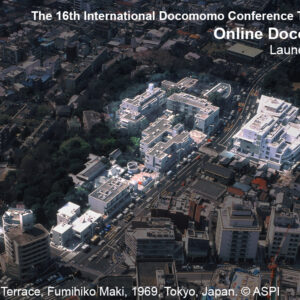
In the context of the 16th International Docomomo Conference Tokyo Japan 2020+1, Docomomo International invites bachelor and master students to participate on the Online Docomomo School 2020+1 Tokyo, happening from 26th July to 4th August 2021. Online Docomomo School is an online-workshop for succeeding and proceeding URBAN HERITAGE. People lived, live and will live in the living heritage. It is not a symbol or memorial but something active that is to be weaved with contexts of history for future. Students in Tokyo as physical sensors will find and show strings of the context and International Online Teams will weave with…
Dear friends, Thanks to your effort and support, 2020 was definitely a very different year due to the COVID-19 Pandemic. However, we all kept working hard in this new normal, even in distance Online or by Zoom. Hoping that 2021 will be a better year! A special thanks to docomomo International sponsors (CML and IST), to all the chapters and their teams, to the partners, to the institutional and individual members. docomomo International could not continue working without your invaluable collaboration and wish you a healthy happy New Year 2021. Keep safe. Best regards, Ana Tostões docomomo International Chair
“From 15-17 November 2021, the ETH Zürich Department of Architecture will host the conference ‘Histories of Urban Design: Global Trajectories and Local Realities’. This conference is organised jointly with the TUDelft Department of Architecture. 2021 will mark the 65th anniversary of the first conference on urban design, held at Harvard’s Graduate School of Design in 1956. Today, more than six decades later, urban design, as a discipline and practice, remains as relevant as ever – perhaps even more relevant than ever before. It is widely acknowledged that our time is an urban age. More people live in cities than ever…
“Toxics. Toxins. Toxicants. Toxicity. These terms slip in and out of architecture, design, and urban planning discussions, shifting between scientific, medical, legal, and social meanings. But what does the history of toxics reveal about the history of architecture? From nineteenth-century arsenic-laden wallpaper to present-day chemical sensitivity–inducing formaldehyde, increasingly industrialized building practices have created both new products and new modes of consumption, production, regulation, and disposal. Over the last one hundred years, building materials have become increasingly composite—made by cutting, mixing, extrusion, cross-lamination, and even nanomaterial microscopic manipulation. These processes can covertly introduce toxic substances into the architectural spaces we inhabit….
“The AHRA PhD Symposium 2021, hosted by Sheffield Hallam University School of Architecture, seeks to ask how architectural research might be embedded within different organisations, places and networks in multiple ways, thus beginning to redefine the role of such research and its relationship to the city. While embedded and ethnographic methods have become more widespread, we see potential in further exploring the particular approaches, relations, networks and collaborations that emerge from socio-spatial studies within or between urban organisations, agencies, Municipalities and groups. The organisers welcome contributions from PhD students in architecture, urbanism, landscape and related disciplines to share the methodologies,…
“For its coming issue, the journal Perspective asks the question of what it means to inhabit: to inhabit a space, a territory, one’s home or one’s body, whether we are dealing with far away frontiers, or the outlines of intimacy; to inhabit one’s life, one’s society/ies, one’s epoch, in what inhabiting means in terms of being present in one’s world, for and with one another, to face circumstances as they stand. In a time when, across the globe, entire populations are confined to their homes, Perspective issues an invitation to revisit the visual and imaginary plasticity of inhabiting: “to occupy…
Docomomo International is pleased to announce that a release of the docomomo France bulletin dedicated to high-rise buildings in France, Les immeubles de grande hauteur en France. Un héritage moderne 1945-1975, will be available from 27th January 2021 also in English. Also, there is an editor’s discount of 40% and free shipping (17 Euros instead of 28 Euros) for docomomo international members! Publication director: Richard Klein Editor in chief: Riccardo Forte Editorial secretary: Milena Crespo Editorial coordination: Léo Noyer-Duplaix and Marjorie Occelli The authors: Caroline Bauer, Silvia Berselli, Catherine Blain, Gauthier Bolle, Bénédicte Chaljub, Audrey Courtebaisse, Milena Crespo, Amandine Diener, Philippe…