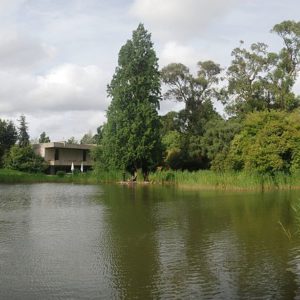
On the occasion of the 50 years celebration of the Gulbenkian Buildings and Garden, the Gulbenkian foundation dedicates one day to the debate on architecture and the insertion of Gulbenkian buildings in the city of Lisbon. On December 10th, the afternoon begins with a round table, curated by Gonçalo Byrne, where the President of Docomomo International, Ana Tostões, will join the discussion on Gulbenkian’s buildings and garden – past, present and future; followed by the launch of photographer André Cepeda’s book Gulbenkian. The day ends with a lecture on the garden’s new expansion project with Japanese architect Kengo Kuma. Live…

Dear Docomomo Chapters, Dear Docomomo International members, Docomomo International would like to remember you to renew your membership for the year 2020, before 15 December, in order to assure that you receive the 2020 Docomomo Member Card in time to benefit from the membership advantages the whole year! Contact your national or regional chapter. If you want become a new member and a Chapter exists in your country (please see Chapters page), you should proceed to formalize your membership by writing an e-mail to them. Otherwise, you can become an International Member, directly at https://www.docomomo.com/join/membership/. Individual Benefits (60€/year) Docomomo International members…
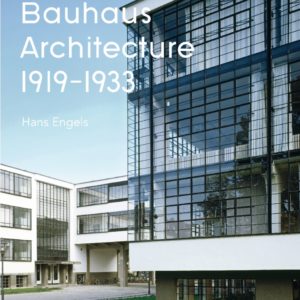
“Focusing on buildings designed by Bauhaus members from 1919 to 1933, this book features some 65 famous and lesser-known building projects in Germany, Vienna, Barcelona, Prague, and Budapest by architects including Walter Gropius, Marcel Breuer, and Ludwig Mies van der Rohe. Arranged chronologically, Bauhaus Architecture offers informative commentary along with photographs, taken especially for this book. Engels’ photographs show many buildings in their newly restored condition and reflect the full range of Bauhaus architecture, one of the most influential schools of architecture in the 20th century.” From the publisher. To order this book, please visit this website.
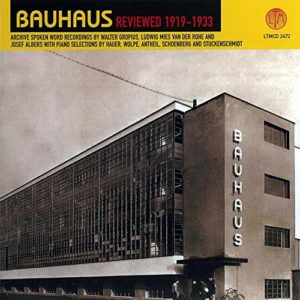
“This full-length archive CD explores the highly influential Bauhaus school of art and architecture, which operated in Germany between 1919 and 1933. The spoken word element is centred on a revealing talk by Walter Gropius, the architect and theoretician who founded the Bauhaus in 1919. The album also includes contributions from the school’s third and final director, architect Ludwig Mies van der Rohe, as well as teacher Josef Albers. All interviews are in the English language. The musical content features piano pieces written between 1919 and 1925 by six composers associated with the Bauhaus: Arnold Schoenberg, Josef Matthias Hauer, George…
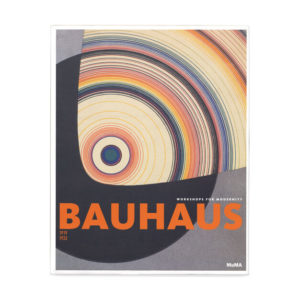
“Bauhaus 1919-1933: Workshops for Modernity, published to accompany a major multimedia exhibition, is The Museum of Modern Art’s first comprehensive treatment of the subject since its famous Bauhaus exhibition of 1938. It offers a new generational perspective on the twentieth century’s most influential experiment in artistic education, and examines the extraordinarily broad spectrum of the school’s products. Many of the objects discussed and illustrated here have rarely if ever been seen outside of Germany. Featuring approximately 400 full-color plates richly complemented by a range of documentary images, Bauhaus 1919-1933 includes two overarching essays by the exhibition’s curators, Barry Bergdoll and Leah Dickerman;…
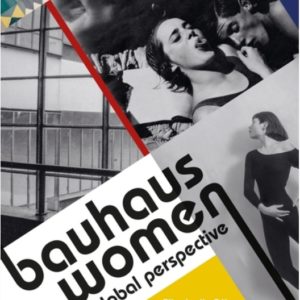
“Bauhaus Women: A Global Perspective reclaims the other half of Bauhaus history, yielding a new understanding of the radical experiments in art and life undertaken at the Bauhaus and the innovations that continue to resonate with viewers around the world today. The story of the Bauhaus has usually been kept narrow, localized to its original time and place and associated with only a few famous men such as Walter Gropius, Marcel Breuer, Paul Klee, Wassily Kandinsky, and László Moholy-Nagy. Bauhaus Women: A Global Perspective bursts the bounds of this slim history by revealing fresh Bauhaus faces: Forty-five Bauhaus women unjustifiably forgotten…
“Bauhaus Goes West tells the fascinating story of the journey taken by the Bauhaus – both the concept behind the school and some of the individuals who represented it – from Germany to Britain and the United States. It is therefore a story of cultural exchange, not only between the Bauhaus émigrés and the countries to which they moved, but also in the other direction, focusing in particular on Britain. Most significantly, perhaps, it considers in detail the presence in the UK during the 1930s of three of the school’s most important figures – Gropius, Marcel Breuer and László Moholy-Nagy –…
“A comprehensive travel guide dedicated to Germany’s Bauhaus architecture, this book takes an in-depth look at over 100 locations that can still be visited today. Established in 1919 in Weimar, the Bauhaus college for design influenced one of the world’s most important Modernist movements. Divided into three geographic sections that follow the locations of the school—Weimar (1919–25), Dessau (1925–33), and Berlin (1933)—this unique travel guide leads readers through the most important Bauhaus structures in Germany. Each section features important sites that are given historical background. These entries are illustrated with historic and contemporary photography, and are accompanied by up-to-date tourist…
“From its inception in 1919, the Bauhaus was a truly international institution. Students and teachers travelled from Croatia, Hungary, Japan, Palestine, Russia, Switzerland and the United States to Weimar and later Dessau and Berlin to become part of the school, drawn to the Bauhaus because of its cosmopolitan, avant-garde perspective and hands-on curriculum. This outlook was reflected in the way the school received and interpreted diverse influences, ranging from Arts and Crafts to reform pedagogy, from Eastern spirituality to constructivism, machine production and the Neues Bauen (New Building) movement. Art and design at the Bauhaus also contained a transcultural element,…
The Lisbon School of Architecture of the University of Lisbon (FA_ULisboa), together with the Graduate Program in Architecture and Urbanism – Faculty of Architecture and Urbanism of the Mackenzie Presbyterian University – (PPGAU FAU-UPM) and the Graduate Program in Architecture and Urbanism (POSURB-ARQ), of the Pontifical Catholic University of Campinas (PUC Campinas) invite students of masters and doctoral programs in Urbanism and young researchers of related disciplines to participate in the 12th International Seminar on Urbanism. The Call for Abstracts for the International Seminar on Urbanism, XII SIIU 2020 is now open! The seminar will be hosted by Mackenzie Presbyterian University, in São Paulo,…