Born as a creative response to the confinement and physical distancing to combat the COVID-19 pandemic, the virtual platform aims at sharing and promoting digital best practices related to culture and cultural heritage from across Europe and the world. Through the platform, citizens, civil society organisations and so many cultural (heritage) operators can connect, interact and learn from one another across various types of borders and barriers. Today so many citizens and organisations are learning and adapting – in such a quick pace – to live, work, learn and communicate in a different way, often from home and in self-isolation….
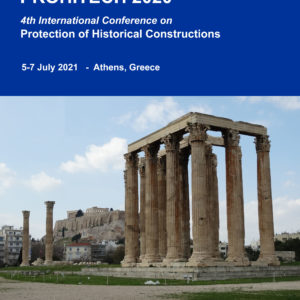
[Message from the Organizing Committee: Dear PROHITECH 2020 participants, With regard to the COVID-19 virus epidemic, and the uncertainty that is likely to persist globally for the following months, the Organizing Committee decided that it would be best to postpone the PROHITECH 2020 Conference by one year. The Conference will be held on 5-7 July 2021 at the same venue in Athens. The registration fee payments as well as the submitted contributions are automatically transferred to the new dates and no action is required from your side. For other organizational matters, eg. postponement of the important dates, as well as the publication of the proceedings in Springer,…
Architects and critics use different tools to manifest the imagination of the otherwise distant and invisible, to design, describe and appraise future and past constructions in absentia. Beginning already in the ancient world, architecture was often practiced as an itinerant art – architects moving to the location of a building opportunity and consulting on projects away from home. In the fifteenth century, as architects like Leon Battista Alberti began working on drawings and models at a scholar’s table rather than the construction site, they expanded the possible distance between design and building. The printed word and image accompanied these developments…
The Museum of the Romanian Peasant is seeking contributions for its annual journal Martor 26/2021, on the topic of Visual Ethics after Communism. Martor is a peer-reviewed academic journal, established in 1996, indexed by EBSCO, Index Copernicus, CEEOL, AIO, and MLA International Bibliography, with a focus on cultural and visual anthropology, ethnology and museology. This special issue to appear in 2021 will problematize the often-uncritical use of images in publications and displays about communism. This themed issue will pose a number of questions for anthropologists, historians, museologists and others. When does an image or a museum display present itself as problematic and for whom?…
The Society of Architectural Historians is now accepting abstracts for its 74th Annual International Conference in Montréal, Canada, April 14–18, 2021. Please submit an abstract no later than 11:59 p.m. CDT on June 3, 2020, to one of the 33 thematic sessions, the Graduate Student Lightning Talks or the Open Sessions. SAH encourages submissions from architectural, landscape, and urban historians; museum curators; preservationists; independent scholars; architects; scholars in related fields; and members of SAH chapters and partner organizations. Thematic sessions and Graduate Student Lightning Talks are listed below. The thematic sessions have been selected to cover topics across all time periods and architectural styles. If…
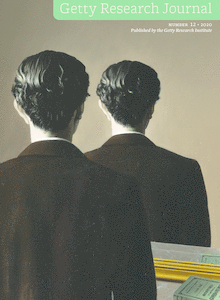
Docomomo International is pleased to announce that the Getty Research Journal will begin biannual publication in 2021. Submissions are invited for the inaugural fall issue. Published twice a year, in February and in August, the journal will continue to feature the work of art historians, museum curators, and conservators around the world as part of the Getty’s mission to promote the presentation, conservation, and interpretation of the world’s artistic legacy. Articles are peer reviewed. We welcome submissions of original scholarship relevant to the Getty’s initiatives, research projects and themes, and collections. The Getty Research Journal is distributed in print and…
Docomomo International is glad to announce that Docomomo Iran published the first issue of its newsletter. Docomomo Iran Newsletter is in pdf format and will be published every month (based on Iranian solar calendar). The language of the newsletter is Persian and it consists of five sections: The Foreword, One Architect; One Building, An Adaptive Reuse Project, and News from the World. The newsletter can be downloaded from Docomomo Iran website. To read the full Newsletter click here.
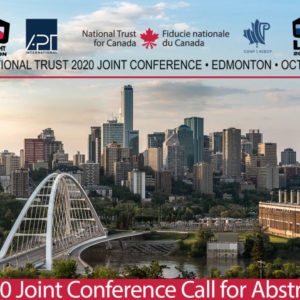
[Dear members and Supporters, The difficult decision by the boards of APT and the National Trust for Canada to switch the Edmonton 2020 conference to a virtual event set off two months of intense activity by the joint APT/NT/CAHP planning team. The team has worked hard to reimagine what our annual conference will be like online rather than in-person. First, we focused on modifying the program already developed for Edmonton, adapting it to a remote, digital format. Our goal is to make the content and social events as engaging and interactive as possible. Next we had to evaluate the technology needed to…
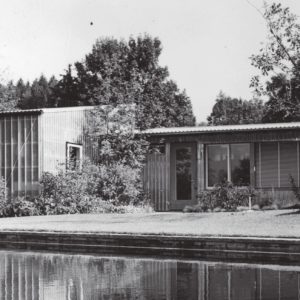
Docomomo France shared with Docomomo International the opened letter concerning the pavilion of Berta Rahm (1958). “Dear Sir or Madam, At the beginning of February this year, the research team of the new SNSF project (National Fund Switzerland) on the Saffa 1958 (Swiss Exhibition on Women’s Work) at the Haute École des Sciences Applées from Zurich (ZHAW) learned of the existence of a pavilion from the Saffa 1958. A sensational discovery for us and the scientific community. The pavilion of Berta Rahm, an unknown and unfortunately forgotten architect, is not only a jewel architecture of the 1950s. She is also…
Docomomo International is glad to announce that the Villa E-1027 located in Roquebrune-Cap-Martin, France, design by Eileen Gray (1929) is fully restored and saved from demolition. Often ill treated by its successive owners, one of whom was murdered on the spot, the villa, emptied of its furniture, was in a severely degraded condition when it was acquired in 1999 by the Conservatoire du Littoral, a coastline conservation body that is part of France’s Ministry of Ecological and Inclusive Transition, which already owned the Cabanon. A decade later, a decision was made to restore the villa, which had been modified by…