Due to COVID-19 Docomomo Belgium is organizing 3 online ZOOM conferences. After the first two conferences, the III Online Lecture will be held on 28th January 2021 by Sébastien Charlier and Thomas Moor with the title “The collection of Modern and Contemporary Architecture Guides”. CONFERENCE III | Thursday 28th January 2021, 20:00-21:30 | online (Sébastien Charlier and Thomas Moor – The collection of Modern and Contemporary Architecture Guides) [in French]. Doctor in History, Art and Archeology, Sébastien Charlier is specialized in architecture history and scientific manager of GAR-Archives of Architecture (Faculty of Architecture, ULiège). Since 2014, he and Thomas Moor…

Docomomo International is pleased to announce that the inscriptions for the XIII edition of the Biennial Architecture Thesis Contest [Concurso Bienal de Tesis de Arquitectura] hosted by Fundación Arquia will begin on 1st February and be open until 26th March 2021, 12 pm (GMT +1). One of the aims of Fundación Arquia is to promote and encourage cultural activities in the field of architecture. Among these activities the arquia/tesis collection pretends to edit and publish architecture PhD theses, that are seen as a relevant contribution to architectural knowledge, once they have been reviewed and adapted to the editorial line by…
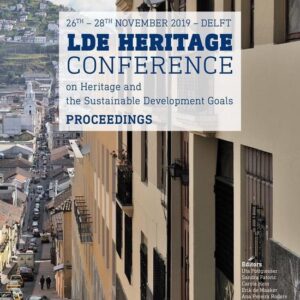
Docomomo International is pleased to announce the publication of the Proceedings of the International LDE-Heritage Conference on Heritage and the Sustainable Development Goals (SDGs), taking place from 26-28 November 2019 at TU Delft, The Netherlands. “Heritage – natural and cultural, material and immaterial – plays a key role in the development of sustainable cities and communities. Goal 11, target 4, of the Sustainable Development Goals (SDGs) emphasizes the relation between heritage and sustainability. The International LDE Heritage conference on Heritage and Sustainable Development Goals, which took place from 26 to 28 November 2019 at TU Delft in the Netherlands, examined…
Abstract
Jean-Pierre Watel (1933-2016) has not been forgotten in the history of contemporary architecture. Gérard Monnier recounts the architect’s success in the 1960’s, his single-family houses and a domestic modernity largely linked to his design of North European-style houses: a central living room, an assumed horizontality and large sections of glass. His main constructions were mentioned or have featured in the professional magazines as well as in the more mainstream press - ensuring recognition from his peers and the aspirations of potential clients. The houses grouped together into new towns were also lavishly commented on for their stylistic affiliations
Keywords
Modern Movement,
Modern architecture,
Jean-Pierre Watel,
Modern housing.
Issue 63
Year 2020
Pages 89-91
DOI: https://dx.doi.org/10.52200/63.A.UG2EFZB8
Abstract
Against the backdrop of the Bauhaus centenary in 2019, Encounters with Southeast Asian Modernism examined the history, significance, and future of postcolonial modernism in this region, with partners in four cities – Jakarta, Phnom Penh, Singapore, and Yangon. The project provided a historical perspective on the societal and political upheaval that accompanied the transition to independence after the colonial period in these countries. It also showcased current initiatives in the fields of art, architecture, and science that are committed to the preservation and use of Modernist buildings. In 2020, the project will continue with an exhibition and accompanying program in Berlin.
Keywords
Modern Movement,
Modern architecture,
Tropical architecture,
Modern diaspora,
Design with climate,
Bauhaus,
Southeast Asia modern architecture.
Issue 63
Year 2020
Pages 85-88
DOI: https://dx.doi.org/10.52200/63.A.SV57ESUX
Abstract
The Makkasan Train Factory, opened 110 years ago, is the first industrial estate in Thailand and used to be the biggest hub for train production in Southeast Asia. Nowadays, this huge land of 80 hectares, with direct access from the Savarnabhumi airport rail link, is considered a golden land right in the business center of Bangkok, that attracts real estate investors. A third of the land set aside at the end of last year for the development of a mixed use commercial project as a part of the High Speed Train project. As this land is the last big area of public land in the capital, civic groups for urban heritage conservation and the environment tried to point out its tangible and intangible heritage value hoping that there would be a proper master plan to preserve these values for future generations.
Keywords
Modern Movement,
Modern architecture,
Tropical architecture,
Modern diaspora,
Design with climate,
Makkasan Train Factory,
Thailand modern architecture.
Issue 63
Year 2020
Pages 80-84
DOI: https://dx.doi.org/10.52200/63.A.D5DS2INS
Abstract
The focus of this contribution is on the importance of tropical architecture in the work of Leandro V. Locsin, in the context of post-WWII in Asia. Based in the Philippines, Locsin is immersed in the Christian tradition – the main religion of a country that was dominated by the Spanish crown from the mid 16th-century to 1898, and where the Catholic Church remains powerful across much of the archipelago today. Attention is focused on Locsin’s religious buildings and projects, where he succeeded in giving a new treatment to the tropical architecture of faith-based structures, through the integration of climate considerations and the reinterpretation of vernacular architecture of the Philippines.
Keywords
Modern Movement,
Modern architecture,
Tropical architecture,
Modern diaspora,
Design with climate,
Leandro V. Locsin,
Modern churches,
Philippines modern architecture.
Issue 63
Year 2020
Pages 76-79
DOI: https://dx.doi.org/10.52200/63.A.61SVZA7Z
Abstract
The idea of environmental design – or loosely referred to as “tropical architecture” – is an ever-present but underlying discourse in modern Indonesian architectural history. Despite being tentative and, at times, overshadowed by other dominant issues, the quest for climate-related environmental tropical design is apparent in almost every generation of Indonesian architects.
Keywords
Modern Movement,
Modern architecture,
Tropical architecture,
Modern diaspora,
Design with climate,
Indonesian modern architecture.
Issue 63
Year 2020
Pages 70-75
DOI: https://dx.doi.org/10.52200/63.A.GBS0QKW3
Abstract
An examination of the architectural value of the Japanese Embassy in Mexico, designed by Kenzo Tange, Pedro Ramírez Vázquez and Manuel Rosen Morrison, which is in danger of being demolished. The context of mid-century Mexican architecture is addressed in order to situate this work within its historic moment, thus confirming its importance. This building was the result of an intellectual encounter between one Japanese and two Mexican architects, who exchanged ideas, concepts and criteria, resulting in a building with an innovative formal design, due to the use of reinforced concrete, and the flexibility of its structural concept, which allows it to be adapted to different uses. This article is essentially based on the archive of the architect Manuel Rosen Morrison, held by the Archive of Mexican Architects at the National Autonomous University of Mexico’s Faculty of Architecture.
Keywords
Modern Movement,
Modern architecture,
Tropical architecture,
Modern diaspora,
Design with climate,
Kenzo Tange,
Japanese Embassy in Mexico.
Issue 63
Year 2020
Pages 62-69
DOI: https://dx.doi.org/10.52200/63.A.4X21D76S
Abstract
Parallel to the discourse of Tropical Architecture and the work of UK architects in the British colonial territories in the Middle East, Africa, and India after the WWII, climate adaptation designs or devices such as brise-soleil, perforated cement bricks, sun shading screens, courtyards, etc., started to emerge in modernist buildings in Asia. This article is a preliminary survey of these cases in Hong Kong and Macau since the 1950s. It discusses how tropicality was used in response to the post-war revisionism of Modern Movement that placed emphasis on local identity and culture.
Keywords
Modern Movement,
Modern architecture,
Tropical architecture,
Modern diaspora,
Design with climate,
Hong Kong modern architecture,
Macau modern architecture.
Issue 63
Year 2020
Pages 56-61
DOI: https://dx.doi.org/10.52200/63.A.9U06Q3RS