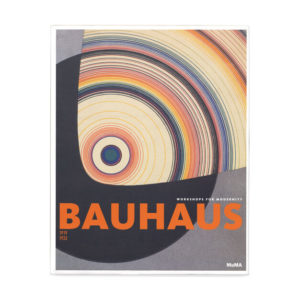
“Bauhaus 1919-1933: Workshops for Modernity, published to accompany a major multimedia exhibition, is The Museum of Modern Art’s first comprehensive treatment of the subject since its famous Bauhaus exhibition of 1938. It offers a new generational perspective on the twentieth century’s most influential experiment in artistic education, and examines the extraordinarily broad spectrum of the school’s products. Many of the objects discussed and illustrated here have rarely if ever been seen outside of Germany. Featuring approximately 400 full-color plates richly complemented by a range of documentary images, Bauhaus 1919-1933 includes two overarching essays by the exhibition’s curators, Barry Bergdoll and Leah Dickerman;…
“Bauhaus Women: A Global Perspective reclaims the other half of Bauhaus history, yielding a new understanding of the radical experiments in art and life undertaken at the Bauhaus and the innovations that continue to resonate with viewers around the world today. The story of the Bauhaus has usually been kept narrow, localized to its original time and place and associated with only a few famous men such as Walter Gropius, Marcel Breuer, Paul Klee, Wassily Kandinsky, and László Moholy-Nagy. Bauhaus Women: A Global Perspective bursts the bounds of this slim history by revealing fresh Bauhaus faces: Forty-five Bauhaus women unjustifiably forgotten…
“Bauhaus Goes West tells the fascinating story of the journey taken by the Bauhaus – both the concept behind the school and some of the individuals who represented it – from Germany to Britain and the United States. It is therefore a story of cultural exchange, not only between the Bauhaus émigrés and the countries to which they moved, but also in the other direction, focusing in particular on Britain. Most significantly, perhaps, it considers in detail the presence in the UK during the 1930s of three of the school’s most important figures – Gropius, Marcel Breuer and László Moholy-Nagy –…
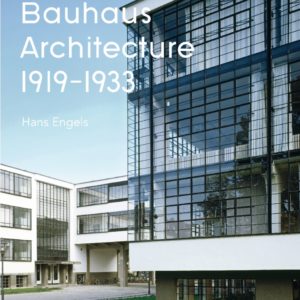
“A comprehensive travel guide dedicated to Germany’s Bauhaus architecture, this book takes an in-depth look at over 100 locations that can still be visited today. Established in 1919 in Weimar, the Bauhaus college for design influenced one of the world’s most important Modernist movements. Divided into three geographic sections that follow the locations of the school—Weimar (1919–25), Dessau (1925–33), and Berlin (1933)—this unique travel guide leads readers through the most important Bauhaus structures in Germany. Each section features important sites that are given historical background. These entries are illustrated with historic and contemporary photography, and are accompanied by up-to-date tourist…
“From its inception in 1919, the Bauhaus was a truly international institution. Students and teachers travelled from Croatia, Hungary, Japan, Palestine, Russia, Switzerland and the United States to Weimar and later Dessau and Berlin to become part of the school, drawn to the Bauhaus because of its cosmopolitan, avant-garde perspective and hands-on curriculum. This outlook was reflected in the way the school received and interpreted diverse influences, ranging from Arts and Crafts to reform pedagogy, from Eastern spirituality to constructivism, machine production and the Neues Bauen (New Building) movement. Art and design at the Bauhaus also contained a transcultural element,…
The Lisbon School of Architecture of the University of Lisbon (FA_ULisboa), together with the Graduate Program in Architecture and Urbanism – Faculty of Architecture and Urbanism of the Mackenzie Presbyterian University – (PPGAU FAU-UPM) and the Graduate Program in Architecture and Urbanism (POSURB-ARQ), of the Pontifical Catholic University of Campinas (PUC Campinas) invite students of masters and doctoral programs in Urbanism and young researchers of related disciplines to participate in the 12th International Seminar on Urbanism. The Call for Abstracts for the International Seminar on Urbanism, XII SIIU 2020 is now open! The seminar will be hosted by Mackenzie Presbyterian University, in São Paulo,…
‘Housing Builds Cities’ Urban Planning (September vol. 4 issue 3, 2019) A brief note from the editors describes the aim of this thematic issue: Far from nostalgically celebrate the 90th anniversary of the second CIAM, which indeed opened in October 1929 in Frankfurt, the present issue is intended as collective work, a springboard which aims to widen the debate over housing experiences beyond geographical and temporal frameworks. The focus of that event, the Existenzminimum, has often been cited as representing a fundamental contribution to the rational design of the modern dwelling. But, the debates during that event went beyond the definition of this concept, because…
The Escuela de Arquitectura – Universidad de Navarra is pleased to announce that the digital version of Revista de Arquitectura – RA 21 (2019) – Architecture for Museums / Arquitectura para los museos (guest edited by Pedro Ignacio Alonso) has come out and it will soon be available in physical format too. The previous issue of the publication, RA 20 (2018) – Nature as Construction Material, is now available open access and can be accessed throught its website. A new call for papers has been launched for the RA 22 (2020) with the theme Material Oriented Ontology. The deadline to…
A call for applications is being held for 10 PhD positions located at ten academic institutions from across Europe, funded in the frame of the innovative PhD training program “TACK/Communities of Tacit Knowledge: Architecture an its Ways of Knowing”. ‘TACK / Communities of Tacit Knowledge: Architecture and its Ways of Knowing’ is a newly funded Innovative Training Network, as part of the Marie Sklodowska-Curie Actions within the European Framework Program Horizon 2020. It trains young researchers in understanding the specific knowledge that architects use when designing buildings and cities. TACK gathers ten major academic institutions, three leading cultural architectural institutions as well as nine distinguished…
Reglazing Modernism – Intervention Strategies for 20th Century Icons Angel Ayón, AIA, LEED AP Uta Pottgiesser, PhD, Architect, Prof. Nathaniel Richards, LEED AP The extensive use of exterior glazed enclosures is one of the most character-defining features of Modern architecture. After decades in service, these facade components have fallen into disrepair and now pose numerous challenges. Consequently, many pre- and post-war steel frame window walls, curtain walls and ribbon windows have been altered to address decay, reestablish functionality and improve appearance or performance. The resulting interventions have prompted important discussions around issues of heritage conservation, building science and sustainability. Focusing…