Fabrications: The Journal of the Society of Architectural Historians, Australia and New Zealand invites papers for a special issue (volume 31, no.1) on Writing Automobile Histories edited by Marianna Charitonidou, ETH Zürich, National Technical University of Athens and Athens School of Fine Arts. Papers are due by 29 June 2020 (EXTENDED). The point of departure for this special issue is the hypothesis that the view from the car has established a new epistemology of the urban landscape. Focusing on the views from the car produced by architects will help us better understand how this epistemological shift influenced architectural thinking and…
TEMPORÁNEA. Revista de Historia de la Arquitectura is a journal of the editorial seal of the University of Seville EUS, preferably addressed to the academic community focused on international research in History of Architecture. It publishes annually scientific articles selected by the double-blind peer review system and through an editorial process characterized by quality, rigor and transparency, monitored by its editorial team committee with a marked international character. Research in the History of Architecture is approached from any discipline, chronological period and geography, and promotes the diversity and complexity of History as an inalienable value. In addition to this transversal and…
The Call for Papers for the 8th issue of Revista Eviterna is open for receiving papers (Articles, Varia, Exhibition&Art reviews, biblio/books reviews). All the interested are invited to collaborate in the eighth number, whose topic line will be -Questions of art in general-. You can find the appointment rules, bibliography and the template to which the articles should be adapted in the section “Author Guidelines” of Revista Eviterna’s website. To receive articles and review them, the author must register on the web with the role of “Author”. In order to launch the eighth issue of the journal in September 2020,…
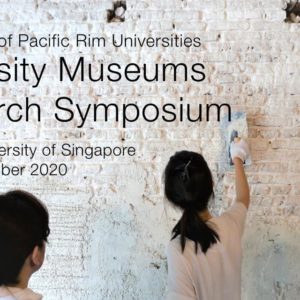
SYMPOSIUM THEME This year’s symposium will reflect on the architectural heritage of universities, their deployment for the activities of the institution, the potentials of these historic structures in fostering academic research and education, and the challenges they present to their owners. The sub-themes of the symposium are developed to encourage personnel from across the university – faculty, undergraduate and postgraduate, estate management, development office – to participate in discussion, debate and reflection. Architectural heritage as a pedagogical resource Historical architecture on campus are landmarks in the institution’s history; steeped in the collective memories of students across generations, they enhance the…
In a 1995 article on the renewal of architectural criticism, French architect and critic Bernard Huet referred to Charles Baudelaire to define art criticism as necessarily – in the poet’s words – “partial, impassionate, political”. During the 1990s, perhaps as a reaction to the 1980s, when in many specialized publications architectural criticism was identified as “communication” or even as promotion of architects and architectures, it emerged an extensive nostalgia for a notion of criticism associated to the historical avant-gardes. In this “committed” criticism or in the “politicized” one it was possible to emphasize the critic’s influential and active role in…
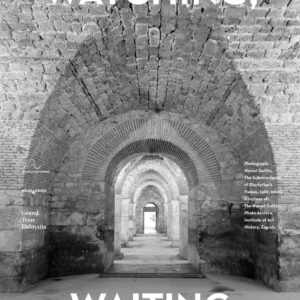
The Institute of Art History – The Cvito Fiskovic Centre in Split calls for papers for an international conference of academics and professionals: “Watching, Waiting – Empty Spaces and the Representation of Isolation”. Across the globe, the year 2020 was unexpectedly marked by the COVID-19 pandemic. Photographs of empty public spaces – the locations of historic events, celebrations, protests, social gatherings, crowds of tourists – from Milan, Paris, London, Istanbul, and Hong Kong to Dubrovnik and Split… these sights stir up bittersweet emotions. On the one hand, these pictures are intensely beautiful. They recall artist’s books and historical photographer’s monographs…
Docomomo International wishes to convey the most sincere condolences at the passing of the professor and historian of Spanish art, Antonio Bonet Correa, to his family and friends. Antonio Bonet Correa (La Coruña 1925-Madrid 2020), was one of the most distinguished figures in the conformation of art history in Spain if not its inventor. He was a handsome man, distinguished-looking, a little French in taste and form; he had a shrewd sense of humor and a capacity for storytelling that captivated those willing to go beyond what was expected in the second race. Professor Bonet, Don Antonio – as the…
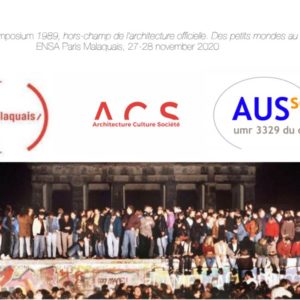
The symposium entitled “1989, hors-champ de l’architecture officielle. Des petits mondes au Grand” is organized by the ACS, Architecture, Culture Société/UMR AUSser 3329 Laboratory and will be held on 27 and 28 November at ENSA, Paris Malaquais. The team is asking for contributions from researchers, teachers and practitioners in architecture and in social sciences. Proposed communications should be submitted by 29 June 2020. Bellow is the call for communications and its practical arrangements. For the symposium to take place in the best possible conditions, it may be postponed in the view of the current health situation. Deadline for submitting propositions: 1st…
Docomomo International wishes to convey the most sincere condolences at the passing of the Spanish architect, Carlos Martí Aris, to his family and friends. “On the first of May, the architect, historian, critic, and editor Carlos Martí Aris passed away in Barcelona, the city where he was born in 1948. He was a leading intellectual compass within the profession in Spain, and a prominent member of the brilliant generation of Catalan theorists that also included Ignasi de Solà-Morales, Josep Quetglas, and Félix de Azúa. He earned his architecture degree in 1972, and his doctorate in 1988, from the Universidad Politécnica…
“This publication not only presents current insights on urban heritage management, but it brings these views together in an integrated manner” observes Robert Quarles, Secretary General of OWHC. “This report is a very welcome and timely inventory which helps to identify the interconnectedness of current urban development challenges in World Heritage cities, such as over-tourism, non-compliance in construction, unsustainable use of resources, population pressure, infrastructure and traffic pressure, pollution and a shortage of (affordable) housing”. The study highlights the importance of the involvement of citizens and community groups in urban planning cooperation, intercity cooperation and the development and financing of…