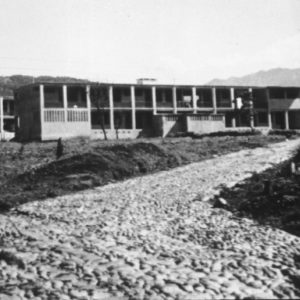
The project of the clinic was commissioned in 1938 by the Mexican Modern Movement pioneer Charles Leduc Montano. The building was built between 1939 and 1942 in functionalist style as one of the first buildings of its kind in Chiapas. Its main characteristics are functional “H”plan, simple beauty of the architectural volumes without superfluous decoration and long and ventilated corridors that promoted rest areas appropriate for patients in recovery. The building was constructed with at-the-time innovational technique – reinforced concrete combined with mud wall. It had also featured flattened cement-sand, polished floors, wooden doors and windows and mosquito nets, all…
“An Edinburgh based architect, Gordon Duffy has launched a website to save a Listed boiler house by Peter Womersely in the Scottish Borders. The boiler house, completed in 1977 has been lying empty and Duffy has won Listed Building consent and Planning consent for the adaptive reuse of the building, transforming it into five residential units. Not unlike the Bofill cement factory near Barcelona, the project uses the embodied energy in the structure to increase lifetime of the building. Stimulated by a love of the beautifully composed concrete structure, Duffy has used the rhythm of the structural bays as a…
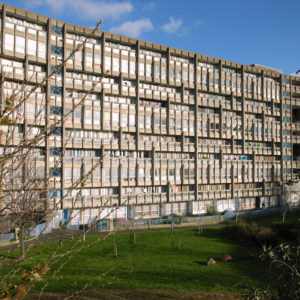
The Robin Hood Gardens (Poplar, London), a post-war housing complex, designed by Alison and Peter Smithson and dating back to 1972, is facing an eminent complete destruction. Being one of the most important social post-war housing projects of Britain, it will be a great loss to erase an outstanding example of architectural quality with great historic interest. It is urgent to act before the complete demolition of this project. For this reason, docomomo International would like to encourage everyone to join the efforts of docomomo UK and worlwide experts in the struggle of preserving this invaluable housing complex. Ana Tostões, Chair of docomomo International, addressed…
The UQ School of Architecture and the State Library of Queensland, in collaboration with the Queensland Department of Environment and Heritage Protection have launched a film competition, entitled ‘HOT AND BOTHERED – Save Modern Queensland’, which invites Queenslanders to submit a 3-minute film on a mid-century modern building in Queensland that they love. The prize for the winner of this competition is 1500 AUD. More details: website. Presentation Clip [by Docomomo Australia]
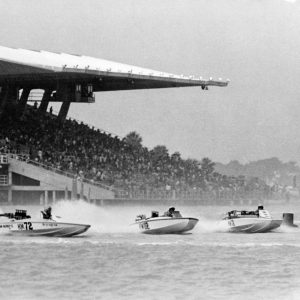
“Less well known than its European and Latin American counterparts, but unique for its direct relation to a water stadium, the Marine Stadium Grandstand in Miami is a cast-in-place concrete 100-meter long building with an eight-section hyperbolic paraboloid roof (2). It is 33-meter wide with a cantilever of 20 meter over the stands; one third of the structure is built on piers into the water. Used for motorboat racing and various types of concerts on a floating stage, the 6566-seat grandstand was built at the edge of a Circus-Maximus-like water stadium, designed and landscaped to face the stands. Hilario Candela, a Cuban architect…
Opened on 1 March 1930, The Majestic Theatre was built for John Fuller & Sons. Billed as ‘The Showplace of Christchurch’, the Art Deco building contained three upper floors of offices, known as Majestic House. It is Christchurch’s first fully steel-framed building. The building is a Group 2 scheduled heritage building, of ‘national or regional significance’. This landmark building in Christchurch’s central city is to be demolished. More than 235 listed heritage buildings have been demolished in Christchurch city and suburbs and in Lyttelton over the three years since the earthquake emergency. Heritage buildings are still being demolished by CERA:…
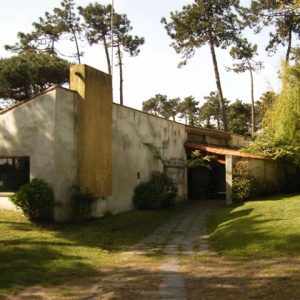
The Ofir House by Fernando Távora, 1956-1958 Casa Dr. Fernando Ribeiro da Silva, Ofir, Esposende, Minho The Ofir holiday house was the first work by Fernando Távora (1923â€2005) published in the Arquitectura magazine (nº 59, July 1957). It was presented as a work that searched a personal language which reconciled the values of traditional Portuguese architecture and new technologic and material achievements. The house was built during the period of transition between de 50s and the 60s, standing out in its historical context, opening up the path for a renewed Modern architecture and for contemporary Portuguese architecture; between an architecture…